Photos courtesy of Fabarm USA (except where noted)
The first sporting clays shoot in the USA took place on September 27, 1980, at Remington’s Lordship Gun Club in Connecticut. The 90 participants shot a 30-target “main event” with presentations designed to simulate hunting scenarios. Sporting clays shooting has come a long way since that shoot.
National Sporting Clays Association (NSCA) competitions today can attract nearly 2,000 participants, and the “main event” is just one of many events that shooters compete in. I personally know a lot of shooters who attend some of the larger NSCA tournaments just so they can shoot in the “side events,” such as the pump-action event or the side-by-side event. While these side events are growing exponentially in popularity, manufacturers who are producing shotguns for these events are almost non-existent. The exception to that is Fabarm, which recently introduced the Fabarm Infinite RS side-by-side competition shotgun. The Fabarm Infinite RS was developed from the start to be a target shotgun, with the goal of winning the gold medal at every NSCA side-by-side event.
After picking up the Fabarm Infinite RS, I took it to my workshop to do a detailed inspection. This shotgun came in a Negrini brand hard-plastic case with four latches to ensure it closes tightly and will not open accidentally. Inside the case are four compartments: one is for the barrel with forearm attached, one is for the receiver, one is for the choke tube case, and one is for accessories. The case also has cut-outs for the choke tube wrench and Allen wrenches. The Fabarm Infinite RS goes together like other break-open shotguns, and using two AA hulls I was able to determine this gun has inertia triggers with ejectors that toss the hulls a good distance behind the shooter.
The Fabarm Infinite RS that I received weighed 8 pounds, 4 ounces and balanced right at the hinge point. This balance is achieved in part by using high-grade aluminum alloy for the rib and not steel, which would need to be soldered onto the barrels and thus increase the muzzle weight.
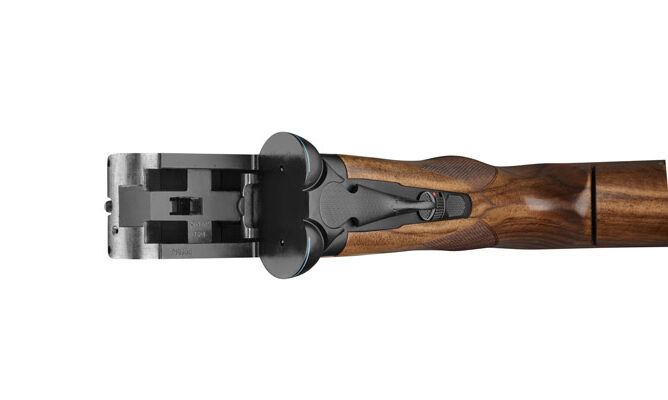
Using the Robert Louis Company Shotgun Combo Gauge, I measured the pitch to be 5 degrees and the Length Of Pull (LOP) to be 14.75″ with the non-removable trigger in the middle of the 1″ long adjustment rail. Since I like to shoot a LOP just less than that, I used the wrench provided to easily move the trigger to the back of the rail. The recoil pad which came on the gun is a 22mm wide black rubber of medium firmness. Fabarm is unique in that shooters can purchase from the Fabarm website different recoil pads in widths of 12mm and 27mm (which when swapped out makes the LOP 14″ or 15 1/8″, respectively). And these recoil pads can be swapped out by the shooter — not requiring a gunsmith to fit them. Another nice feature a shooter can add to his Fabarm Infinite RS without needing a gunsmith is to add the Fabarm 180g recoil reducer to the stock.
With the adjustable comb in the lowest position, mounting the Fabarm Infinite RS presented me with two beads with the mid-bead partially covering the front bead. Since I like a sporting shotgun that shoots a Point Of Impact (POI) of 55/45, I did not change the comb height — as I would pattern it at the range to confirm this POI as is. After re-inserting the two AA hulls, I used my trigger-pull scale to determine the weight of both triggers was 3.75 pounds.
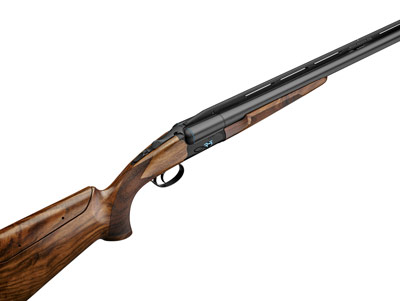
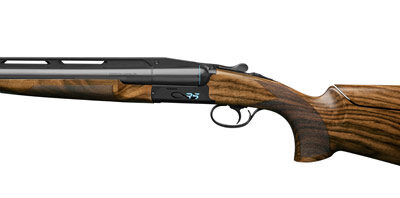
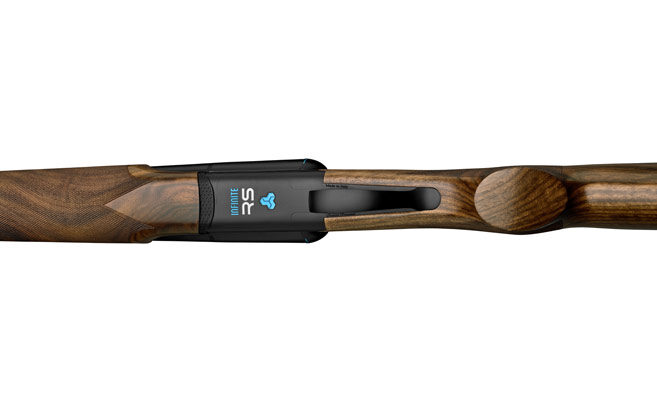
The Fabarm Infinite RS I received had a good-looking piece of Turkish walnut for the stock and forearm. The pistol grip on the Fabarm Infinite RS has a palm swell that fills the hand extremely well, giving the shooter a very solid feel of control. This model comes standard with an adjustable comb, allowing the shooter to move it up and down (for height changes) as well as right and left (for cast changes). The enclosed wrenches make these adjustments quite easy.
The recoil pad is just slightly curved to ensure a good fit in the shoulder when mounted but not curved so radically it would be an issue for shooters who like to use a low, or off-the-shoulder, mount. The checkering on both sides of the pistol grip is not aggressive at all, and feels very comfortable to hold with bare hands while also preventing slippage when a shooter’s hands are damp.
The receiver is blued with the infinity symbol and the letters “RS” written on each side (the letters “RS” is in light blue lettering integrated into the right side of the infinity symbol). The bottom of the receiver has “INFINITE RS” written in blue and white letters. Behind the top lever is a combination safety and barrel selector lever. Changing which barrel to fire first, as well as engaging the safety, is easy and very straightforward. Pushing the safety lever backward displays the letter “S” in a circle and shows the shooter the safety is engaged. The shooter will move the barrel selector left-and-right to determine which barrel fires first. When a single dot is showing, the right barrel fires first, and when two dots are showing, the left barrel fires first. One feature the Fabarm Infinite RS has which I really like is the barrel selector can be changed without having to engage the safety first. The safety mechanism is manual, so it will not engage automatically each time the barrel is opened.
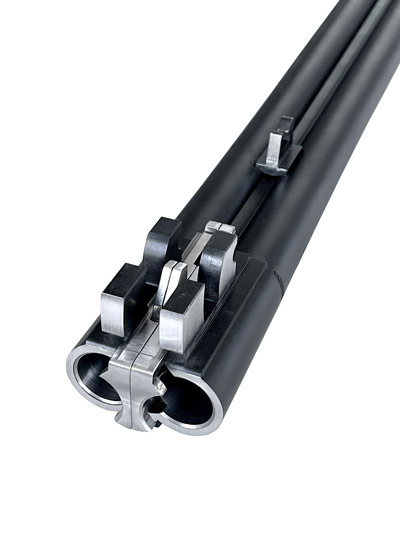
The Fabarm Infinite RS I tested had 32″ non-ported barrels with a measured constriction of .725. The raised aluminum top-rib is tapered, going from 10mm to 8mm, and comes standard with two beads — a white Bradley-style at the muzzle end and a silver steel bead in the middle. Raising the rib helps to bring the shooter’s eyes up above the side-by-side barrels and gives the shooter a similar sighting plane as his competition over/under, making the transition between his normal over/under and this side-by-side almost indistinguishable.
The Fabarm Infinite RS comes with five chokes (Skeet, Improved Cylinder, Modified, Improved Modified and Full) which are 4″ in total length, with 5/8″ extending beyond the muzzle. The part of the choke tube which extends beyond the muzzle has the choke constriction written on it, and it is knurled at the very end for easy gripping.
The Fabarm Infinite RS has a semi-beavertail forearm using an Anson push-rod iron to release the forearm from the barrels. The checkering on the forearm matches that of the pistol grip. The wood-to-metal finish throughout the entire shotgun was excellent.
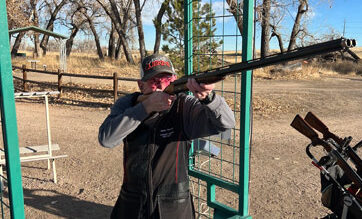
To test the Fabarm Infinite RS, I took the shotgun to Colorado Clays in Brighton, Colorado. This range has an outstanding patterning board setup with well-marked yardage distances. For my POI testing, I used Federal Top Gun heavy #7½ target shotshells with a Modified choke in each barrel from 20 yards. I was surprised to see that with the bead alignment I saw and the comb in its lowest position, both barrels show a nearly perfect 50/50 POI (with half the shot hitting above where I was pointing and half the shot hitting below where I was pointing). So, I raised the comb ~1/8″ and repeated my POI patterning. That additional 1/8″ gave me a visual “figure-8” with the two beads and brought up the pattern to a nice 55/45 POI with both barrels. For pattern-distribution testing, I moved back to 35 yards and put up a 30″-diameter circle pattern. After firing three shots from each barrel with the same ammunition with both the Modified and Full chokes, the distribution on all four patterning papers showed an outstanding distribution of the 393 pellets…with no holes and no clumping.
Shooting a side-by-side shotgun feels different than shooting an over/under shotgun. The most noticeable difference is how the hand which is on the forearm grips the forearm. With an over/under, the hand on a beavertail-style forearm essentially wraps around the bottom barrel and only the top barrel is above the fingers. With a side-by-side shotgun, both barrels sit above the hand. The Fabarm Infinite RS has a semi-beavertail style forearm, allowing the forearm to be wide enough to contain the bottom of each barrel. This allows the shooter’s forearm hand to solidly hold both barrels and not have their fingers wrap around the barrels themselves.
The feeling of having side-by-side barrels felt strange for me for the first three stations. During those 20 shots, I struggled to get my hand in a good position. While shooting targets on the third station, I set my hand such that my index finger pointed straight in line with the forearm iron and the Anson push-rod. From that point forward, I never gave my forearm hand a second thought.
The pre-printed scorecards at Colorado Clays has a shooter shoot either six or eight shots at each of the 15 stations such that upon completion the shooter has taken 100 shots. The target presentation at these 15 stations is always changing, as the course manager is diligent about changing things up for the weekly sporting clays league. By using the foliage and topography of the land the range sits on, there are always some very challenging shots. And, while the course manager ensures there is a good mix of incoming, outgoing, crossing, looping and chandelle targets, this particular individual has a real liking for rabbit targets.
I completed the course with a score of 87. In reviewing my scorecard, I noticed a majority of my 13 misses were on Stations 1, 2 and 3 where I was trying to get a comfortable grip with my forearm hand. Another thing I noticed in reviewing my scorecard was I did not miss any rabbit targets. I believe the reason is having the two side-by-side barrels on the same horizontal plane as the rabbit target gave me a very easy visual reference point for shooting this type of target.
Bottom line is the Fabarm Infinite RS is a fun gun to shoot! And it shoots exceptionally well. It is built with all the great features that Fabarm builds into all of their competition shotguns. At the time of this writing, the MSRP of the Fabarm Infinite RS was $6,175.
While many shooters will grab their grandfather’s side-by-side hanging above the fireplace and be very happy hitting 50% of the targets they shoot at the side-by-side events, shooters who want to hit all the targets in the side-by-side events will find the Fabarm Infinite RS is the gun to own and shoot! SS
Mark H. Taylor has over 40 years of shooting experience. He has won many regional, state, national and international clay target competitions. He is the author of the book Clay Target Shooting – The Mental Game and co-author of the book Break ’em All. Mark is a NRA Certified Advanced International Shotgun Coach and a High-Performance Shotgun Coach for USA Shooting. He is a Caesar Guerini and Cabela’s (in Thornton, CO) Pro Staff shooter, and teaches monthly beginner shotgun clinics at Colorado Clays in Brighton, CO, and travels nationally and internationally teaching coaching courses and working with world-class athletes. You can email him at [email protected].