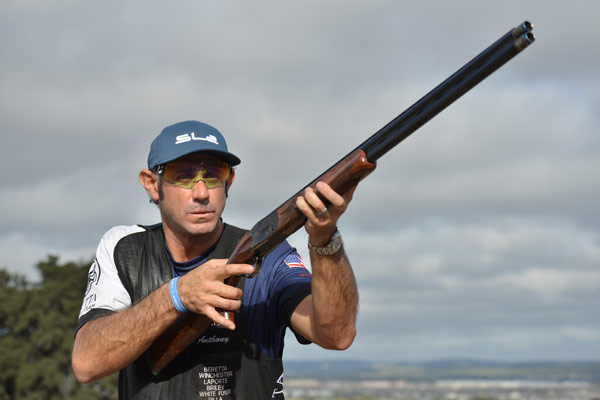
Photos and diagram courtesy of Anthony I. Matarese Jr.
Editor’s note: Chapter 20 “Visual Opportunity” is reprinted from the book “Straight Shooting” by Anthony I. Matarese Jr. with permission from the author.
Let me tell you a story. It involves the biggest evolution of my game, one that I believe was critical in helping me win my two world championships.
In early 2016, I went to Quail Creek Plantation in Florida for the annual Gator Cup. It’s one of the first big shoots every year, and it’s a great opportunity to escape winter and shoot in warmer weather. I always go when I can.
In the weeks leading up to the tournament, I had practiced a lot, had worked on my routine, and I felt confident that I would have a strong start to the season. As I usually do, I signed up for the preliminaries. I use them to fine-tune my game before the main event.
The morning preliminary had a lot of targets thrown at what I call in-between angles—sort of crossing, sort of going away. You could see the targets a little more clearly than you would on a typical trap shot, but not so well as you would on a crosser. You simply didn’t have enough time to really lock your eye on the target and finish the shot.
Well, when the preliminary was over, there were a bunch of scores in the mid- to high 90s. I had shot 85. And I wasn’t happy.
I knew I was struggling. My plan was good, and so was my routine. But I couldn’t see the clay well, and as I struggled, I started taking my eye off the targets and measuring, trying not to miss instead of working to hit them. It happens to all of us, and on that day, it happened to me.
As I thought back, I realized that most of those targets weren’t easy to see and didn’t give you much time to focus. For starters, it was cloudy and the background wasn’t great. If I had a traditional crossing shot, I could lock onto the clay and kill it. I ran most of those stands. But if a target combined angle and speed to create a very small window of opportunity, I was in trouble.
To make a long story short, I was trying to see the clays too clearly and was locking on them for too long. I was trying to see a level of detail that just wasn’t possible, at least not for me on that day. As a result I was hanging on to the clays and getting careful, and in the process, I was losing the feel part of the shot, which is critical for consistency. In other words, my eyes weren’t ready when the target was at its ideal break point. I had made a visual error—and it resulted in a timing error.
Until that point in my shooting career, I had always tried to see the target better when I was struggling. If I missed, my first assumption was that I hadn’t seen the target well enough. Clearly, that wasn’t working in this situation.
I resolved to try something else: I would shoot the target where it gave me the best visual opportunity and would fire at that spot, even if my eye wasn’t 100 percent locked on.
I worked on this idea in the afternoon preliminary, and I shot a little bit better.
On Saturday, I went out determined to work hard and to commit myself to this idea of maximizing my visual windows of opportunity. It was a typical championship-level course, and if anything it was rougher than the course that gave me fits on Friday.
I shot 100 straight. I put together another good round on Sunday and won the tournament, and I went on to have a great year, including a victory at the World Sporting Championship in England.
This realization about visual opportunity changed my shooting career. On my good days, I’m 1 or 2 percent better than I used to be. The improvement on my “off” days is more like 2-4 percent. I’m a much better shooter because I now fully understand this concept and embrace it in my shooting.
You can do the same, but it’s not easy. Let me explain.
What This Means
This is a complicated topic, and not one for the beginning or intermediate shooter. You need to have enough experience to recognize when you have one of those birds that don’t give you a good visual opportunity. Beginning and intermediate shooters generally don’t use their eyes all that well, so they should concentrate on focusing on the target as well as possible.
But at some point, you must understand what to do when the target doesn’t give you a chance to lock on. Instead of trying to achieve the impossible, you need to make the most of whatever opportunity you have, and that is the purpose of this chapter.
Understanding Opportunity
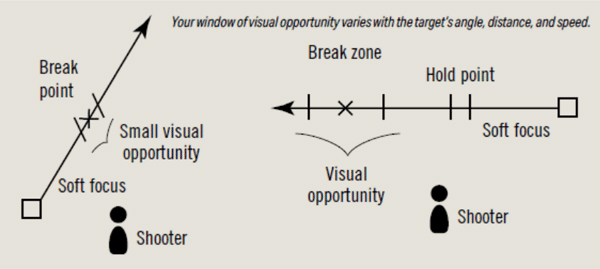
To begin with, every target has a visual window of opportunity. Some give you a big window, others a small one. On some of the tougher targets thrown today, it may not happen at all. If you try to get hard focus on an extreme, fast quartering or going-away bird as it approaches the break point, you’re going to be in trouble. That’s what happened to me at the Gator Cup.
So let’s agree that there is a difference between focus and seeing the clay as well as possible. You still want to shoot targets where you can see them best, but that doesn’t always mean you will be able to see them in crisp focus.
Visual opportunity means being able to see the clay as well as the clay allows, and it varies from target to target, and from station to station.
Recognizing the visual opportunity each target provides should be a part of your pre-shot planning and routine. Think about it in terms of framing a snapshot or video in your mind of the target as it enters the break point. Sear it into your memory. Ask yourself, “How well can I see the target, how clearly will I see the target, and how long will I see the target?” That’s your visual opportunity.
Let’s take a standard crosser, thrown up in the sky or against a good background so that you can see it extremely well. You should be able to pick out some detail—the rim of the clay, a shiny spot, a shadow, or where the orange meets the black. You should have a lot of time to see the bird and run with it, and because it’s a crossing shot, you will have more of a break zone where you see the bird the best, as opposed to a break point.
That’s a huge visual opportunity.
Now consider a fast, trap-style going-away bird. Even under the best of circumstances, you’re only going to have a fraction of a second of clear focus on a bird like that, and working harder to see the bird isn’t going to make that split second any longer. If you get clear focus, that’s awesome—but if you don’t get it, you need to shoot anyway. Otherwise the bird is gone, and all you’re doing is poking and hoping. That’s a short visual opportunity.
A double-trap simo pair is even more challenging. You’re going to have to shoot the first bird early with a lot of trust, and it’s very unlikely that you’ll have time to get any kind of focus. You must “shoot the blur,” as my friends say, and it’s a skill every top shooter needs.
Or think about a fast, quartering trap-teal with some distance. That’s a bird on which you have very limited visual opportunity because it’s going to be behind your barrel. You don’t worry about that—you shoot.
On some extreme targets, it’s impossible to get focus, period. Some are like the birds I struggled on in the Gator Cup preliminary—far, fast, angling away. You must accept that you’re going to shoot at a bird that is not very clear when you pull the trigger, and plan for it.
In summary: You should work to see every target as well as possible, but when it comes to vision, not all targets are created equal. A one-size-fits-all approach to vision and seeing the target may not work at advanced levels of the game.
Maintaining Visual Discipline
This is the hardest part of the game, and it’s a struggle that never ends—you simply get better at recognizing when your discipline starts to slip.
Some days, it’s easy to get a good visual lock on the target, and on others it’s very difficult. The solution can vary as well—you may need to concentrate harder on your planning and routine, and other days you need to “let go” a bit more than usual. Regardless, the goal is the same: Get the best possible visual connection with the clay.
At the 2021 Western Regional in Arizona, I had an exceptionally strong FITASC competition. On my first layout, I simply misread a target and shot 22. Then I killed the next seventy-two birds on three harder parcours before missing again, winding up with a 96 and the championship. During that stretch, I concentrated on my routine and the visualization of what each clay would look like when I shot—clear with crisp detail, or at times, simply a target.
The story was different the next day. My gun’s forearm broke on the first station of the main event. I missed a target on each of the next six stations, all because of mental/visual issues. I couldn’t get my visual discipline back until halfway through the round, and to do that I abbreviated my routine and “let go” a bit. I ran the last seven stands.
It takes a bit of experience to know when to concentrate harder and when to let go. But when you struggle, always assume that vision is the problem. You must learn how to address it.
~ * ~ * ~
Editor’s note: The above excerpts from Straight Shooting by Anthony I. Matarese Jr. were reprinted with permission from the author. For more information about his clinics and A.I.M. Shooting School, see the ad on page 17. To order his book, see the ad in Shootin’ Accessories on page 46.
Anthony I. Matarese Jr. is the first American to win the World English Sporting Clays Championship and the first person to win the sport’s four biggest tournaments: the World English, the World FITASC, the National Championship and the U.S. Open. He is the youngest inductee to the National Sporting Clays Association’s Hall of Fame. Matarese is also one of the world’s leading shooting coaches and instructors, and with his family runs M&M Hunting and Sporting Clays, one of the world’s premier shooting destinations.