

Bartholow Brothers Clinics
You’ve put in the time, burned through cases of shells. Your gun mount feels natural, your swing is smooth and your routine is dialed. On a good day, you feel like you’ve got everything figured out. And then, without warning, it all falls apart. Those targets you know you should hit suddenly become inconsistent. You start questioning your timing, your gun, even your ability.
This is the point in most every shotgun shooter’s journey where progress stalls.
The difference between a shooter who occasionally performs and one who delivers consistent, repeatable results lies in the ability to read and adapt to environmental variables: specifically wind, light and background. These factors don’t just affect the target and your ability to see clearly; they fundamentally alter perception, timing and decision-making.
To be at the top of your game, you need to learn how to manage them. This is where good shooters plateau, and great shooters shine.
The Hidden Layer of Shotgun Shooting
Shotgun shooting is often taught as a mechanical discipline:
- Establish good stance
- Mount the gun consistently
- Find the right hold points
- Follow through
These are essential. But they are only the first layer.
The second layer, the one that determines consistency under varying conditions, is defined by asking yourself the right questions:“What is this target actually doing, and how is the environment changing what I see?”Until you can answer that instinctively, you are reacting to the target’s movements, not controlling the outcome.
Again, this all comes down to wind, light and background. So, let’s deep dive into each topic to make your shooting excel.
Wind: Beyond Direction and Speed
Most shooters reduce wind to a simple concept: “It pushes the target up or down.” That oversimplification is a huge limitation to developing shooting consistency.
Wind does not just push; it reshapes the entire flight profile of a clay target. A clay target is a spinning object with aerodynamic properties.
When wind interacts with it, several things happen simultaneously:
- Velocity Changes – From the moment the clay leaves the thrower, wind will accelerate or decelerate the target
- Lift Alteration – The spinning target generates lift, which wind can enhance or suppress
- Trajectory Deformation – The arc of the target changes shape, not just direction
- Stability Disruption – Targets can wobble, flutter, jump or dive in the air
This leads to a critical realization: The same target presentation is never truly the same in different wind conditions. When you try to keep a constant angle of attack with the same barrel speed, you quickly realize that things don’t sync up.
Start with asking better questions:
- Is the wind steady or gusting?
- Is the target gaining or losing speed during flight?
- How is the target being manipulated by the wind? And, is the flight path arc short (diving quick with wind at your back) or long (rising targets from a frontal wind)?
- Do my hold points need to change with the target change?
- Where are my misses when it’s windy?
These questions shift your mindset from reacting to diagnosing.
Now, all this being said, you can look at all the targets beforehand (which I do recommend), but you need to know how to respond to targets when up on the line shooting.
Reading Wind in Real Time
Elite shooters don’t guess. They observe before ever calling for a target, and they have already analyzed:
- Previous shooters’ targets
- Break points and dust patterns
- Subtle inconsistencies between their shots that change how they need to attack the bird
They are building a mental model of how the target behaves today. And, while you may think changes in your stance, hold points, etc. need to be a drastic change, that’s not the case, either.
A miss in wind often leads to:
- A dramatic change in lead
- A rushed shot
- Loss of confidence
Instead, I urge you to make incremental adjustments:
- Slightly shifting break points
- Subtle timing changes
- Maintaining consistent mechanics and not overthinking it
Wind doesn’t mean a complete overhaul, just a small refinement. However, mentally it can create issues. How many times have you heard “I’m not shooting handicap, I don’t want to tank my average” or “Singles were tough enough; I don’t want to waste my time in this wind.”
I get it, and I’ve been there (with those same excuses). Wind introduces uncertainty, and uncertainty creates hesitation.
The key is not eliminating uncertainty; it’s becoming comfortable operating within it. Confidence in wind comes from trusting your ability to read and respond. Don’t react; read the target and your scores will stay high.
Light: The Distortion of Reality
Wind alters the physical behavior of a target; light alters the perception of it. If you’re not seeing the target well, you don’t shoot where the target is, you shoot where you believe it is.
Your brain processes moving objects based on:
- Contrast
- Edge definition
- Depth cues
- Motion clarity
Lighting conditions directly influence all these, which lead to a critical insight: Light doesn’t just make targets easier or harder to see, it changes how fast and clear they appear.
The Questions Shooters Consider About Light
- Is the target clearly defined or does it blend into the background?
- Does the light enhance or reduce contrast?
- Am I seeing the target clearly enough?
- Does the target appear faster or slower than it actually is?
These questions determine how effectively you process the target, which in turn, will determine the speed and timing at which you react to the bird. If you’ve ever shot at the Grand, you know the shoot-offs start at the worst possible times when the lighting is the toughest: sunset with a wide variety of yellows, oranges and reds, and not much backlighting to pop that target. So how does this lighting trick your brain, and what can you do?
Apparent Speed Distortion and Depth Perception Loss
In flat or lower light, targets often appear slower and as a blur. The duller color of the target makes it tough to lock onto the black/orange contrast, as well as less definition to stay locked onto the target. In certain lighting angles, targets can momentarily disappear.
To combat this, start getting your practice in during low-light time frames. One of the most effective adjustments is changing where you first acquire the target, and finding the right eye placement will determine how quickly you are locking onto the target. Too quick and it’s a blur where your eyes play catch-up; too slow and your reaction time is delayed. That perfect medium is what you need to find.
The small shift in eye placement can improve contrast and enhance clarity by locking onto the bird after its “streak” when coming out of the traphouse.
Equipment Optimization
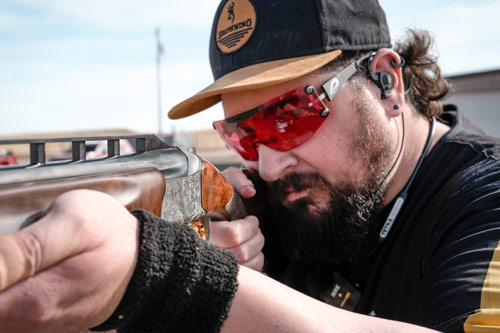
Lens selection is not cosmetic, it is functional. Different tints can enhance contrast, target visibility and eye comfort. Matching lenses to conditions is one of the simplest ways to gain a performance edge. Several top-tier shooters revert to clear lenses in low light or shooting under the lights.
Background: The Overlooked Battlefield
Backgrounds are one of the most underestimated factors in shotgun shooting. Unlike wind and light, it doesn’t change the target’s behavior, it changes your ability to interpret it. When certain colors, shapes or shadows are noticed, our mind and eye’s ability to stay locked on a target can fail. It’s built into the way your eyes work, always moving to interpret an object’s depth, size, color, shape and surroundings.
A quick experiment that proves this. If you stare at a small object, how quickly do you lose your peripheral vision? If you stare at an object too hard for too long without movement, your vision gets blurry and you lose an optical awareness of the room. This is the same effect you get when staring at a target. Your brain is constantly working to isolate the target from its surroundings.
When the background is:
- Clean and uniform → target stands out
- Busy or similar in color → target blends in
The Questions Most Shooters Never Ask About Background
- Does the background change during the shot?
- Am I choosing a break point based on visibility, reaction time or by habit?
- Is the target blending into any part of the background?
Many shooters develop fixed break points based on familiarity, but background conditions can make those points tough to break at that time, and just like lighting, the background will determine your reaction time and how you lock onto a target.
My first and obvious choice is to test out as many color options as possible with my shooting lenses to find what gives me the best overall contrast of the target to the background. One tip is finding a color that will pop the target while muting the color of the background and sky.
If you’re colorblind, several shooters find various colors of reds a good option to test out. The targets can be especially difficult to see in cloudy backgrounds, where the colors of the clouds will turn the targets almost invisible.
If you’ve tried several lenses and still struggling with a tough background, you can always try adjusting your eye placement, speed and breaking point. I would recommend testing out these one at a time, not all together to find what works for you. While not optimal, it’s something to try if all other options have been exhausted.
The Integration of Variables
The true challenge is not understanding wind, light or background individually. It’s managing them simultaneously.
Imagine this combination: a quartering crosswind pushing targets unpredictably, during a late afternoon sun creating glare on one side, with a shady tree line causing background shadows. My recommendation: Observe and understand your lighting conditions, background and wind before stepping up to the line.
Start with the correct shooting lenses for you. If you see a tough shadow on the target that is making it dark, watch the target height. If it’s getting into the sky out of the shady tree line, it will help create definition when popping into the sky. With the sun glare, a bird moving to the left will generally be the tougher target with eyes squinting to maintain visual clarity. Maintain your mental composure and keep consistent mechanics that don’t allow you to start guessing where targets are going to be moving.
Consistency Is Perfected
Most shooters chase consistency through repetition on perfect days, but rarely you see anyone shooting on those tough, dark, misty, rainy, windy days. This is where consistency is perfected by understanding variables outside your control. Shooting on these days will help you:
- Read conditions
- Making subtle adjustments
- Maintaining composure
- Trust your process
- Gain confidence when everyone else wants to quit
Shift from Shooter to Master of All Variables
At some point, every serious shooter must make a transition from focusing solely on your score at the end of the round to understanding:
- How well you performed in the shooting environment
- How you elevated your shooting performance
- How you adapted to consistently break targets
This is where the game changes, because once you begin to see what others overlook, you gain an advantage that cannot be bought. You recognize patterns, you anticipate, you control instead of chase, and most importantly…you stop wondering why you missed.
Remember, it’s never just about pulling the trigger. It’s about reading everything around you and making the right decision in the moment. That’s what separates shooters who occasionally succeed from those who do it every time they step on the line. SS
The Bartholow Brothers, Foster and Matt, are two of the winningest competitors in trapshooting history. In 2008, Foster Bartholow was named Co-Champion along with Leo Harrison III for the Clay Target Championship at the Grand American, after a total of 1,100 targets straight (200 in the CTC program and 900 in the tie-breaking shoot-off). This was the first time in the history of the Grand they named co-champs in a championship event. Their record for the longest shoot-off in the history of the ATA still stands. Matt Bartholow, the Grand Doubles Champion in 2011, 2021, 2022, 2023 and 2025, was the 2600 HOA winner (2553) at the Grand American in 2019. Matt’s three consecutive Grand Doubles Championships set an ATA record. In 2017-18, he held the second longest run in registered doubles with 910 broken doubles targets, and holds the record for second longest run in singles with 1,840 consecutive registered targets broken. For more career highlights as well as clinics and coaching offered by the Bartholow Brothers, visit trapshootingbros.com.